Swap the basslines
Bring in B with its low EQ reduced. At the phrase change, reduce A’s bass while restoring B’s. Keep the bass level consistent through the handover.



Mixing techniques
Refine your transitions with phrasing, EQ, hot cues and loops. Practise each technique in edjing Mix with three focused exercises.
Beatmatching aligns the tempos and beats of two tracks. Sync helps with this alignment in edjing Mix. Tempo is measured in beats per minute (BPM).
Phrasing aligns musical sections. Start the incoming track so its next section arrives at a suitable point in the outgoing track, such as the end of a chorus.
In 4/4, count four beats per bar. Many sections run for four, eight or sixteen bars. Listen for changes in the drums, vocals or arrangement to identify the boundaries.
Practice example · two tracks in 4/4
Start B with eight bars remaining in A’s section. Keep their beats aligned so B’s intro ends as A reaches its next section.
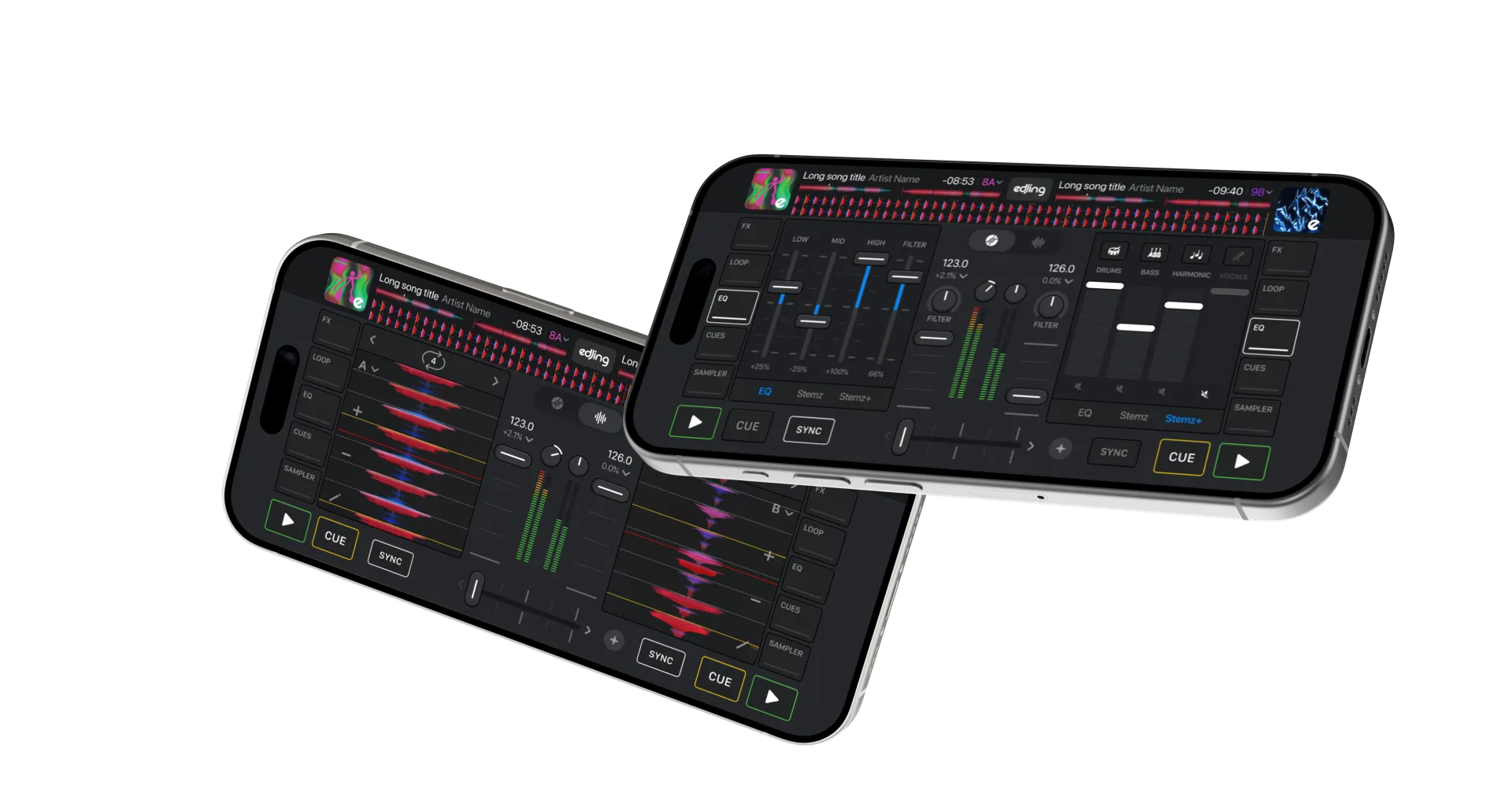
Compare passages with similar energy and adjust the deck levels before mixing. Matching against a quiet intro can make the incoming track too loud when its full arrangement enters.
The crossfader blends the decks. EQ adjusts the low, mid and high frequencies within each track.
Bring in B with its low EQ reduced. At the phrase change, reduce A’s bass while restoring B’s. Keep the bass level consistent through the handover.
Choose an instrumental passage or shorten the overlap when two vocals compete. EQ affects the whole frequency range; use Stemz for separate vocal control on supported tracks.
Reset the EQ on the outgoing deck before loading your next track.
Choose two tracks in 4/4 at a shared tempo. A needs 16 bars before its next section; B needs a 16-bar intro. Avoid competing lead vocals and keep effects off for this exercise.
Start B on the phrase boundary with its bass reduced. Bring in enough of B to hear the beats together. If they drift, correct the alignment before extending the overlap.
Raise B to the level you want for the handover. Listen to the combined midrange and percussion; reduce a competing part rather than increasing both decks.
Reduce A’s low EQ as you restore B’s. Rehearse the exchange until the low end stays consistent without a surge or a hollow gap.
Fade A out before B’s next main section arrives. Stop A once it is inaudible and reset its EQ. B now carries the mix.
If A has an eight-bar outro and B a 16-bar intro, start B eight bars before A’s outro begins, provided that passage leaves room. If it does not, choose another entry point or a shorter blend.
A hot cue saves a track position. Set one at your chosen entry point, then use it to repeat the transition.
Check the phrase before placing the cue: a vocal pickup may start before the first beat of the bar.
Rehearse the entrance until its timing is consistent, then add the EQ handover. Prepare hot cues and performance loops →
Loop a steady instrumental passage to extend the overlap. Check that the repeat point stays in time.
In 4/4, four beats equal one bar; eight beats equal two bars. Check the loop length shown in the controls.
Release the loop at a phrase boundary so the track continues into its next section.
Try a brief Echo on the outgoing deck at the end of a phrase, then fade the deck out. Compare the result with a transition using only levels and EQ.
Keep the effect below the lead vocal and check its ending. Switch it off before loading the next track.
Use the same two tracks for all three exercises. Choose steady beats and similar tempos. Access to tools depends on your app version and offer.
Keep EQ neutral and effects off. Try two entry points for the incoming track. Choose the one that aligns the musical sections.
Repeat the entrance with B’s low EQ reduced. Transfer the bass from A to B at the phrase change without a surge or drop in level.
Loop an instrumental passage to extend the blend. Repeat your level and EQ changes, then release the loop at a phrase boundary.
Record each attempt and compare the timing and balance. Record your practice set →
Combine several transitions. Use longer blends where the arrangements complement each other and shorter handovers where they compete.
Choose harmonically compatible tracks →
Questions & answers
No. Tempo is only one factor. Key, rhythm, vocals and arrangement also affect the blend. Try another passage or a shorter overlap if they clash.
No. Sync helps align tempo and beats. You choose the entry point, musical sections and transition length.
EQ adjusts frequency ranges across a track. Stemz separates vocals and instruments for independent control.
No. Timing, levels and EQ are enough for many transitions. Add loops or effects for a specific musical result.